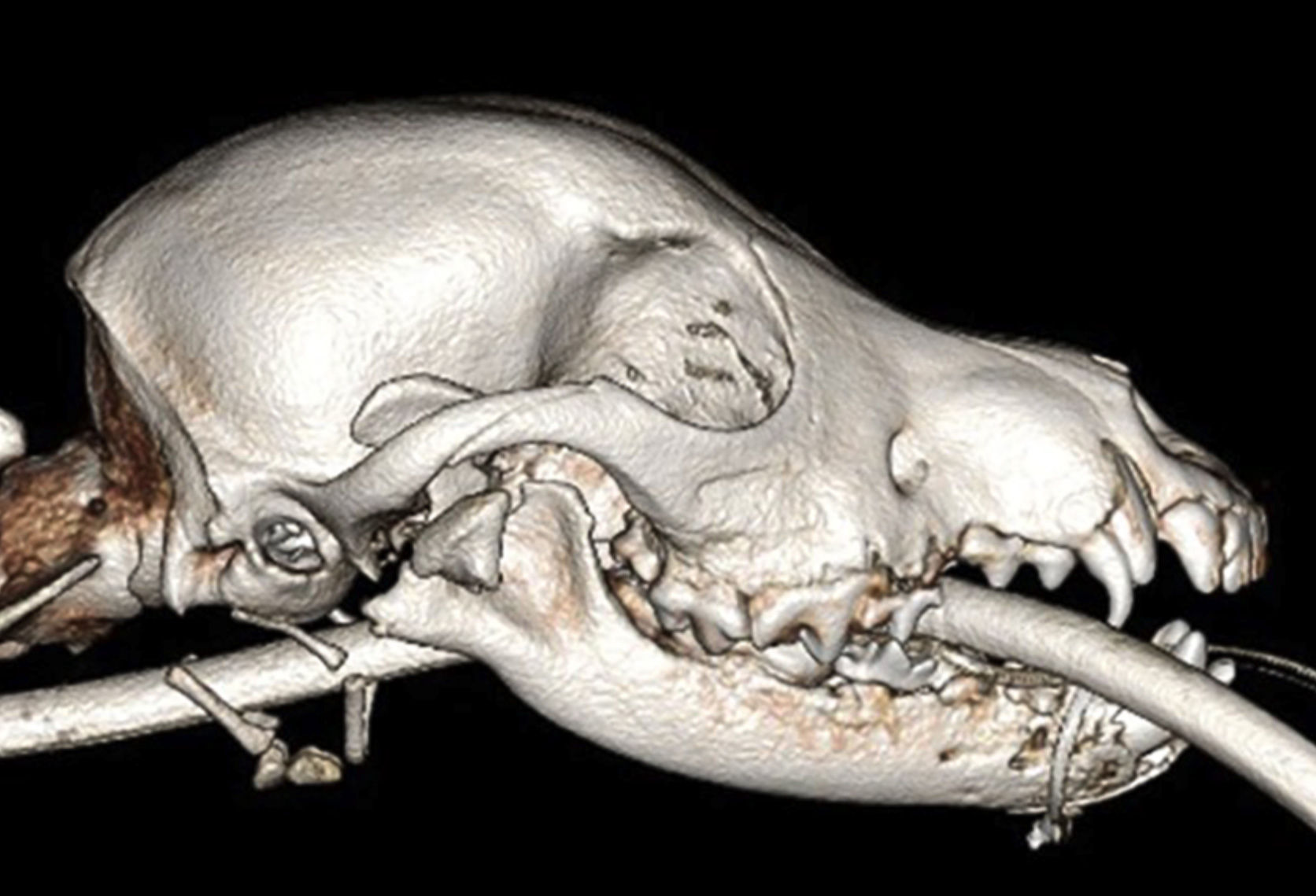
Objective
To determine the biomechanical strength of two different condylar titanium plating systems (trapezoid and lambda condylar plates) in medium to large breed dogs for repair of mandibular condylar fractures under physiologic bite forces
Methods
Using a block study design, twelve medium- to large-breed adult dog cadaver heads were used to simulate a mandibular condylar process fracture. The selected implant was applied to simulated fracture, and the cadavers were loaded in a single-load-to failure test simulating the direction of force of the masseter, temporalis, and medial and lateral pterygoid muscles.
Results
All implants failed at simulated bite forces greater than 600N. The mean force to failure was 1006.5 N (344.7) for the lambda plates and 847.8 N (78.0) for the trapezoid plates. There was no statistically significant difference in mean force to failure when comparing the different types of plates. Some degree of screw pull-out occurred in 50% of specimens tested with the trapezoid plates. There was no significant difference in mode of failure between the two groups. The most common mechanism of failure was breakage of the loading apparatus.
Conclusions
Both condylar lambda plates and trapezoid plates are able to sustain expected physiologic bite forces in domestic dogs after implantation. There is no significant difference in the force to failure for either type of implant.
Clinical Relevance
Based on biomechanical testing, both lambda condylar plates and trapezoid plates are suitable for open reduction and internal fixation of mandibular condylar process fractures in medium to large-breed dogs.